It’s Your Story – Narrative Structure
It’s Your Story: Narrative Architecture and Growth Framework
Table of Contents
- Glossary of Terms
- Narrative Tree: From Epic to Happening
- Map-Based Branching System
- Developmental Pulse System
- Choice and Marker Logic
- Visual Map & Grid Structure
- Adventure Walkthrough Example
1. Glossary of Terms
EPIC
The full one-year interactive adventure made up of 26 Stories. It includes a universal beginning (Story 1) and conclusion (Story 26), with 24 adaptive Stories in between.
SAGA
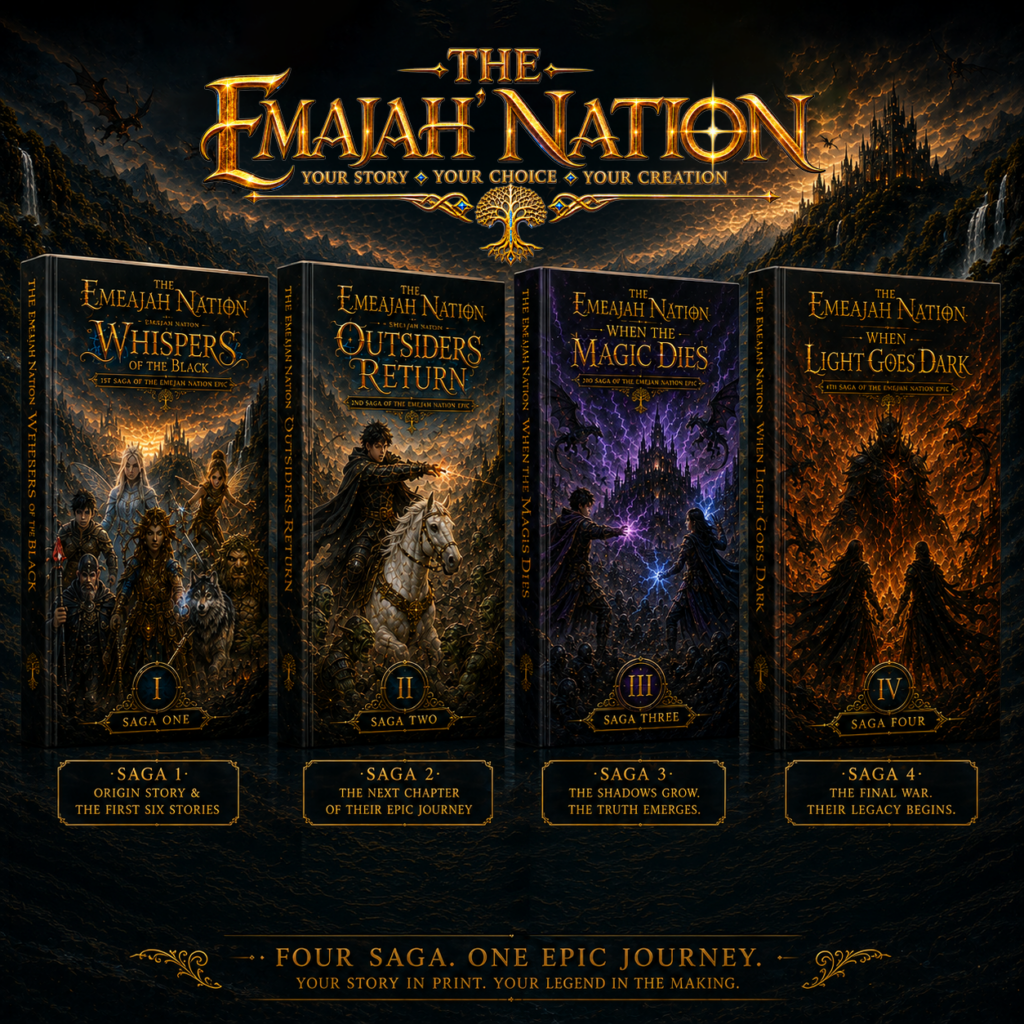
A grouped arc of 6 Stories (~12 weeks). Each Saga has a narrative goal, a developmental focus, and ends in a cliffhanger.
STORY
A 7-day bi-weekly experience. Each Story contains 7 Adventures, builds from a central theme, and contributes to the current Saga.
ADVENTURE
A single daily session (~15–20 minutes) composed of:
- Spark: Video + parent narration
- Wind: Still image + foreshadowing
- Flame: Descriptive text-based moment
- Choice: A decision that leads to a Path
CHOICE
A decision made by the child that drives the narrative. Each Choice is linked to a Path and carries a Pulse.
PATH
The branch the story takes following a Choice. Directs the child’s movement on the world map and selects terrain, destination, and event.
PULSE
The developmental trait being targeted in a Choice (e.g., memory, empathy, critical thinking, leadership).
EMAJAH’ NATION
The in-story world map, divided into Realms (6x6 mile squares). Each Realm contains:
- Terrain (woods, hills, marshes, etc.)
- Destinations (castles, bridges, cottages, etc.)
- Events (narrative Happenings)
REALM
A single square on the Emajah' Nation grid containing its own unique terrain, destinations, and events.
HAPPENING
The narrative moment triggered by reaching a destination via a Path. A story beat involving puzzle, interaction, or challenge.
MARKER
A subtle cue embedded in Spark, Wind, or Flame that sets up a future Choice. Used to test memory, bravery, logic, or emotional inference.
2. Narrative Tree: From Epic to Happening
EPIC (1 Year)
- Story 1: Universal Opening
- SAGA 1: Story 2–7
- SAGA 2: Story 8–13
- SAGA 3: Story 14–19
- SAGA 4: Story 20–25
- Story 26: Universal Closing
Each Story contains 7 Adventures:
Spark → Wind → Flame → Choice → Path → Happening
3. Map-Based Branching System
The Emajah’ Nation map is a 9x9 grid of Realms. Each Realm contains:
- Terrain: e.g., woods, marshes, rivers
- Destinations: e.g., wishing wells, castles
- Events: Happening-based story beats
Paths are influenced by:
- Child’s Pulse profile
- Previously seeded Markers
4. Developmental Pulse System
Each Choice has a Pulse:
- Memory: Recall details
- Empathy: Emotional/moral response
- Critical Thinking: Problem-solving under pressure
- Leadership: Follows or ignores host’s guidance
Scoring is reflective, not punitive. It tracks:
- Behavioral patterns
- Pulse response history
- Emotional and decision maturity over time
5. Choice and Marker Logic
Choices include embedded Markers planted in Spark/Wind/Flame and linked to:
- 1 Reactional Choice (non-directional)
- 1 Directional Choice (movement on the map)
Example:
Spark – Farmer mentions red eagle flying north
Wind – You find a red feather
Flame – You remember the eagle's direction
Choice – Go North (swamp), South (river), or East (cottage)?
6. Visual Map & Grid Structure
The map grid is coordinate-based:
- Y axis (vertical) = 1 to 9
- X axis (horizontal) = -9 to -1
Example Coordinate: 6-8 = Y:6, X:-8 = near a river
Every Happening has at least 3 outbound Paths. Each Path has:
- 3–4 Spark/Wind/Flame segments
- Up to 2 Pulse-based Choices
Location format:
Epic.Saga.Story.Adventure.Realm / MapXY / PulseScore-ChallengeCount-CorrectCount
7. Adventure Walkthrough Example
Each Adventure starts at a new Path. The structure:
- Video plays (Spark)
- Parent reads Spark text
- Wind image + hint
- Flame builds immersion → leads into Choice
Choices:
- Reactional Choice → Tests memory/empathy/logic
- Example: Troll rushes bridge — do you jump or use secret gesture learned 3 days ago?
- Happening reflects the result
- Directional Choice leads to next Realm
Each Adventure includes:
- 3 Happenings
- 2–3 SWF cycles per Happening
- All Choices tied to a Pulse
Data is logged across movement, decision, pulse, outcome.
End of Document